
What Information is on a College Transcript?
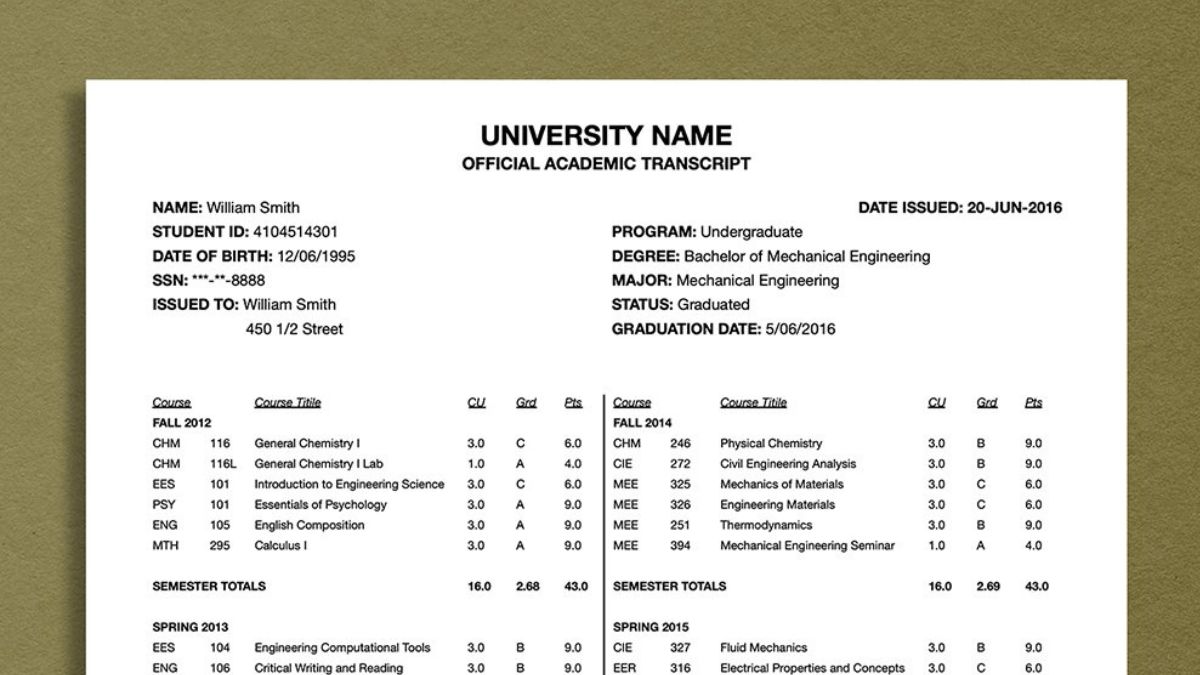
Your college transcript is one of the most important documents in your academic career, yet many students don't fully understand what it contains or why it matters. This comprehensive guide breaks down every element of a college transcript and explains what employers, graduate schools, and institutions look for when they review your transcript.
What is a College Transcript?
A college transcript is an official document issued by your college or university that provides a comprehensive record of your academic performance. It serves as legal proof of your educational history and is requested by employers, graduate schools, and other institutions to verify your academic credentials.
Think of it as your academic resume—a permanent record of every course you took, every grade you earned, and how well you performed.
Key Information Found on a Transcript
1. Student Information
At the top of your transcript, you'll find:
- Full Legal Name: Exactly as it appears in your school's records
- Student ID Number: Unique identifier assigned by the institution
- Date of Birth: Often included for verification purposes
- School Name and Location: The institution granting the degree
- Degree Awarded: Associate, Bachelor's, Master's, or other degree type
- Graduation Date: When your degree was officially conferred
- Major(s): Your primary field of study
- Minor(s) (if applicable): Secondary area of concentration
2. Course Information
For each course taken, transcripts include:
- Course Code: Specific identifier (e.g., ENG101, MATH201)
- Course Title: Name of the class (e.g., "Composition I," "Calculus II")
- Credit Hours: Number of semester or quarter hours (usually 3-4 for regular courses)
- Grade Earned: Letter grade (A, B, C, D, F) or pass/fail designation
- Term Taken: Semester and year completed
- Institution: Where the course was completed (for transfer credits)
3. Grade Point Information
Transcripts display several GPA calculations:
- Overall/Cumulative GPA: Your average across all courses
- Major GPA: Average for courses within your major only
- Institutional GPA: Average for courses taken at this specific school
- Semester GPA: Your average for each term
- GPA Scale: Usually notes whether 4.0, 5.0, or another scale is used
Why multiple GPAs matter: Graduate schools and employers see the complete picture of your performance across different contexts.
4. Credits and Hours
Transcripts include:
- Credits Earned: Total semester or quarter credits completed
- Credits Attempted: Total credits you enrolled in (important if you failed courses)
- Quality Points: The result of multiplying grade points by credit hours
- Cumulative Hours: Total credits toward your degree
These numbers show not just what you learned, but how much coursework you completed.
5. Academic Standing and Status
Your transcript may note:
- Academic Status: Whether you were in "good standing" (passing required GPA)
- Dean's List: Notation if you achieved high academic honors
- Academic Probation: If your GPA fell below minimum standards
- Satisfactory Academic Progress: Important for financial aid verification
- Honors Graduated: Cum laude, Magna cum laude, Summa cum laude distinctions
6. Degree Conferment Information
- Date Degree Conferred: Official day your degree was awarded
- Degree Type: Bachelor of Arts, Bachelor of Science, etc.
- Registrar Signature: Official signature and seal validating the document
- Institutional Seal: Official seal of the university
This information proves your degree is legitimate and officially awarded.
7. Institutional Policies and Codes
At the bottom, transcripts typically include:
- Grade Scale Definition: What each letter grade means
- Special Course Codes: Explanations of symbols like:
- TR: Transfer credit (from another institution)
- IP: In progress
- W: Withdrawn
- P/F: Pass/Fail
- AU: Audit (course taken for knowledge, not credit)
What Doesn't Appear on Official Transcripts
It's equally important to know what's NOT on a transcript:
- Personal Information: Demographic details unrelated to academics
- Discipline Records: Academic misconduct or behavioral issues typically don't appear (though they may be flagged separately)
- Financial Information: Balances owed or payment history
- Medical Information: Health or disability accommodations don't appear
- Social Security Number: Schools now limit this for security reasons
- Comments: Subjective remarks about your abilities or character
Understanding Your Transcript Components
Reading Your Grades
Transcripts show your literal grades, which may vary slightly by institution:
| Grade | Points | Percentage | Interpretation |
|---|---|---|---|
| A | 4.0 | 90-100% | Excellent |
| B | 3.0 | 80-89% | Good |
| C | 2.0 | 70-79% | Satisfactory |
| D | 1.0 | 60-69% | Passing |
| F | 0.0 | Below 60% | Failing |
Some schools use +/- modifiers (A-, B+, etc.), affecting point values.
Understanding Credit Hours
Most courses are:
- 3 Credit Hours: Typical course load (45 contact hours per semester)
- 4 Credit Hours: Lab-based courses with extra contact hours
- 1-2 Credit Hours: Seminars, practicum, or specialized courses
A full-time student usually takes 12-15 credit hours per semester. Your transcript shows the total credits completed and attempted.
The Importance of GPA on Your Transcript
Your GPA on your transcript is crucial because it:
- Shows your overall academic performance
- Helps graduate schools evaluate readiness for advanced study
- Assists employers in assessing your work ethic and competency
- Influences scholarship and financial aid decisions
- Can affect job opportunities, especially for first jobs
For more on how GPA is calculated, read our complete guide to understanding GPA.
Why Colleges Request Transcripts
Graduate School Admissions
Graduate programs use transcripts to:
- Verify undergraduate degree completion
- Evaluate specific coursework relevant to the program
- Assess academic readiness for advanced study
- Compare applicants' performance
- Set conditions for admission (some programs require minimum GPAs in specific subjects)
Employer Requirements
Employers may request transcripts to:
- Verify degree claims
- Assess knowledge in relevant fields
- Screen candidates for positions requiring specific coursework
- Meet compliance or licensing requirements
- Evaluate competency in critical areas (engineering, science, etc.)
Professional Licensing
Certain professions require transcript review:
- Law school bar admissions
- Medical licensing boards
- Engineering certifications
- Teaching credentials
- Financial industry licenses
Transfer Between Institutions
When transferring to another school, transcripts:
- Show what coursework transfers as credit
- Determine your academic standing at the new institution
- Establish your GPA (sometimes recalculated)
- Verify prerequisite completion for advanced courses
Official vs. Unofficial Transcripts
Official Transcripts
- Purpose: Submitted to institutions, employers, graduate schools
- Format: Usually printed on official school letterhead with registrar signature
- Seal: Bears the official institution seal
- Delivery: Mailed directly to requesting institution or delivered in sealed envelope
- Cost: May cost $3-$15 per copy
- Time: Usually 3-5 business days to request and receive
Unofficial Transcripts
- Purpose: Personal reference, initial document review
- Format: Printed from student portal without official seal
- Seal: No institutional seal
- Delivery: You keep and use it
- Cost: Often free from student portal
- Time: Available immediately from online account
Important: Always provide official transcripts for formal requests. Unofficial copies are typically not accepted for important purposes.
How to Request Your Transcript
Standard Process
- Locate the Registrar: Find your school's registrar office website
- Complete Request Form: Submit official transcript request (online or paper)
- Verify Information: Ensure graduation date and degree type are correct
- Provide Recipient: Specify where transcript should be mailed
- Pay Fee: Most schools charge per transcript
- Receive: Official transcripts arrive in 3-5 business days (sometimes faster for rush)
Online Ordering
Many modern universities offer online transcript ordering through:
- Student information system (e.g., Banner, Peoplesoft)
- Third-party vendors (e.g., National Student Clearinghouse, Credentials.com)
- Official institution website
This is usually faster and more convenient than paper requests.
What Employers and Schools Look For
When reviewing your transcript, institutions typically focus on:
Overall GPA
- Most employers prefer 3.0 or higher
- Graduate schools often require 3.0+ minimum
- Competitive positions may require 3.5+
Major-Specific Coursework
- Relevant courses to the position or program
- Advanced coursework showing deep knowledge
- Prerequisite completion for graduate study
Rigor and Progression
- More challenging courses taken
- Improvement over time (showing growth)
- Consistency of performance
Degree Completion
- Verification that degree was earned
- Completion of all requirements
- Legitimate conferral of degree
Special Transcript Notations
Your transcript may include important notations:
- Dean's List: Achieved 3.5+ GPA in a semester
- Summa Cum Laude: Graduated with highest honors (usually 3.9+ GPA)
- Magna Cum Laude: Graduated with high honors (usually 3.7-3.9 GPA)
- Cum Laude: Graduated with honors (usually 3.5-3.7 GPA)
- Academic Probation: GPA fell below 2.0
- Transfer Credit: Courses completed elsewhere that transferred
These notations provide context for your performance.
Understanding Credit Transfer
If you transferred schools, your transcript shows:
- Credits Transferred: Courses from previous institution that counted toward degree
- Credits Counted: How many credits the new school awarded
- Original Grades: Sometimes shown separately from transferred status
- Institution of Origin: Where each transfer course was completed
Important: Not all credits transfer directly; some may transfer as elective credit rather than major credit.
How Long Transcripts Are Kept
Permanent Records: Colleges maintain transcripts permanently. You can request transcripts even decades after graduation.
If your school closes, records are typically transferred to:
- The state education department
- A successor institution
- The National Student Clearinghouse
You can always obtain official documentation of your degree.
FAQ: College Transcripts
Q: Can I view my transcript online?
A: Most schools offer unofficial transcripts through student portals. Log in to your account to check.
Q: How much does a transcript cost?
A: Usually $3-$15 per official copy. Unofficial copies are often free.
Q: Can I request a transcript years after graduation?
A: Yes, colleges maintain records permanently. Request from your school's registrar anytime.
Q: What if I have an incorrect grade on my transcript?
A: Contact your registrar immediately. Grade changes require formal procedures and documentation.
Q: Do failed courses appear on transcripts?
A: Yes, and they factor into GPA. Some schools allow grade replacement; ask your registrar.
Q: How many transcripts do I need?
A: Request enough copies for all applications. It's cheaper to order several at once than individually.
Conclusion
Your college transcript is a permanent, official record of your academic achievement. Understanding what information it contains, why it matters, and how it's used helps you appreciate its significance and use it effectively in your career and educational pursuits.
Whether you're applying to graduate school, seeking employment, or simply want to understand your academic history, your transcript tells a complete story of your college years.
For more on academic credentials, explore our guide to types of college degrees and what employers look for when reviewing educational qualifications.