
Certificate vs. Degree: What's the Difference?
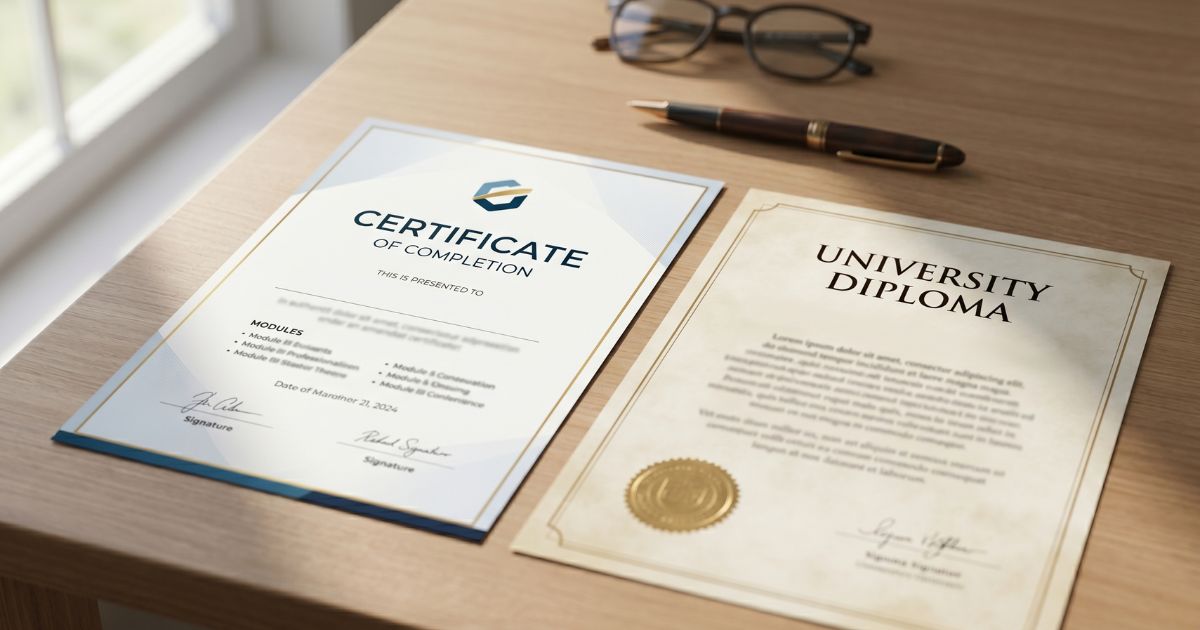
"Certificate" and "degree" get used almost interchangeably in everyday conversation, but they describe two genuinely different things. If you're weighing your options — or just trying to make sense of a job posting that asks for one and not the other — this guide lays out the difference clearly.
The short answer
A degree is a credential awarded by a college or university after completing a broad, multi-year program of study — an associate, bachelor's, master's, or doctoral degree. A certificate is a credential awarded after a shorter, focused program that builds a specific skill or covers a specific subject.
Put simply: a degree is wide and deep; a certificate is narrow and quick.
How they differ
The two credentials diverge across several dimensions:
- Time. A certificate program can take anywhere from a few weeks to a year. Degrees take longer — roughly two years for an associate, four for a bachelor's, and additional years for graduate degrees.
- Depth and breadth. A degree mixes a major with general-education coursework — writing, math, science, electives. A certificate skips the breadth and concentrates on one area.
- Cost. Because they're shorter, certificates usually cost far less than a full degree.
- Entry requirements. Many certificate programs have open or light admission requirements. Degree programs typically require prior credentials — a high school diploma for undergraduate study, a bachelor's for graduate study.
- How employers read them. A degree signals broad capability and staying power. A certificate signals a specific, current skill. Neither is "better" — they answer different questions.
Side-by-side comparison
| Certificate | Degree | |
|---|---|---|
| Typical length | Weeks to one year | 2–4+ years |
| Focus | One specific skill or subject | A major plus general education |
| Relative cost | Lower | Higher |
| Awarded by | Colleges, trade schools, training providers, professional bodies | Colleges and universities |
| Best for | Adding a skill quickly, changing roles, meeting a specific requirement | Building a broad foundation, careers that require a degree |
When a certificate makes sense
A certificate is often the right call when you already have work experience and need to add one capability, when a specific job requires a specific certification, or when you want to test a field before committing years to a degree. Certificates are also popular for staying current — technology and many trades reward up-to-date, demonstrable skills.
When a degree makes sense
A degree is usually the better investment when you're entering a field that requires one as a baseline, when you want the widest range of long-term options, or when you're aiming for roles where advancement is tied to degree level. Many professional paths — and graduate study itself — simply will not open without a degree.
What people mean by a "degree certificate"
Here's a common source of confusion. The phrase "degree certificate" gets used two different ways:
- In everyday and international usage, "degree certificate" often just means the physical diploma — the printed document you receive when you earn a degree. In this sense, a degree certificate isn't a separate credential at all; it's the paper that proves the degree.
- In U.S. higher-education usage, a "certificate" is the short credential described above, distinct from a degree.
So if someone abroad asks for your "degree certificate," they almost certainly mean your diploma. If a U.S. job posting lists "degree or certificate," it means the two different credential types. Context tells you which.
Can you have both?
Absolutely — and many people do. A bachelor's degree paired with a focused professional certificate is a common, strong combination: the degree provides the foundation, the certificate keeps a specific skill sharp. They complement each other rather than compete.
Displaying and keeping your credentials
Whichever credentials you earn, the documents that mark them are worth keeping safe — and worth displaying. A framed degree or certificate in a home office is a quiet, lasting reminder of work you completed.
If an original has been lost or damaged, or you'd like a clean copy to frame while the original stays stored, DiplomaCraft creates novelty replicas: custom certificates recreated from your details, and replica college and university diplomas for degrees. You can also browse the full range of novelty diplomas for display and keepsake use. These are personal keepsakes — not accredited credentials and not issued by any institution — so for anything official you'll always rely on the documents from your school.
The bottom line
A degree is a broad, multi-year credential; a certificate is a focused, shorter one. One isn't a substitute for the other — they answer different questions an employer or program might be asking. The right choice depends on your goal, your timeline, and your budget. And when someone says "degree certificate," check the context: they may simply mean the diploma itself.
DiplomaCraft creates replica diplomas, transcripts, and certificates as novelty items for personal use, display, props, and replacement keepsakes. They are not accredited credentials and are not issued by any institution.