
What Does a Diploma Look Like? A Visual Guide to Diploma Formats
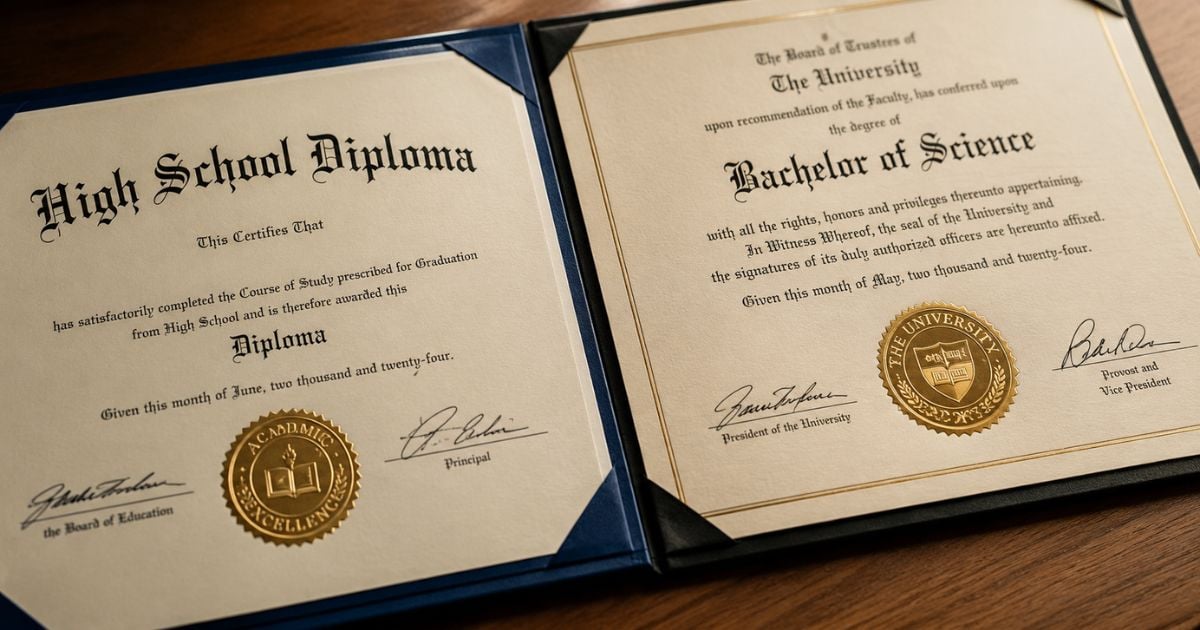
Most people receive a diploma, glance at it, and tuck it away — so when they actually need to picture one, the details are fuzzy. What's written on it? Where does the seal go? Do high school and college diplomas look the same? This guide breaks down what a diploma looks like, part by part.
The elements every diploma shares
Whether it's from a high school or a university, nearly every diploma is built from the same handful of elements, arranged in roughly the same order from top to bottom:
- The institution's name. Set large across the top — the single most prominent line on the document.
- A statement of conferral. Formal wording such as "The Board of Trustees hereby confers upon" or "This certifies that."
- The recipient's name. Centered and set in the largest or most decorative type on the page — the visual focal point.
- The award. What was earned: a high school diploma, or a specific degree such as Bachelor of Science.
- Honors, where applicable. Latin honors like cum laude on college diplomas.
- The date. The graduation or conferral date.
- Signatures. Two or more — typically a principal and superintendent on a high school diploma, or a president, provost, and dean on a college diploma.
- A seal. The official seal of the school, near the signatures, marking the document as genuine.
The overall feel is formal and traditional: a serif typeface, generous spacing, a portrait or landscape orientation, and often a fine border.
What a high school diploma looks like
A high school diploma is usually a single landscape-oriented page. The school district or high school name runs across the top, followed by wording that the student "has satisfactorily completed the course of study prescribed for graduation." The student's name sits in the center in large script or serif type. Below it: the graduation date, then signatures from the principal and a district official, with the school seal beside them.
High school diplomas tend to be a little more restrained than college diplomas — clean, dignified, and not heavily decorated. The paper is typically heavyweight, sometimes cream or ivory rather than bright white.
What a college and university diploma looks like
College diplomas follow the same skeleton but with more ceremony. The university name is often paired with its founding date or a Latin motto. The conferral wording is more formal — "The Board of Regents, on the recommendation of the Faculty, has conferred upon" — and names the specific degree: Bachelor of Arts, Bachelor of Science, Master of Business Administration, and so on.
If the graduate earned Latin honors, cum laude, magna cum laude, or summa cum laude appears near the degree. The signature block is longer — president, provost, dean, sometimes a registrar — and the university seal is prominent. Many universities also print their diplomas in Latin, or use larger formats and heavier embellishment than a high school would.
Professional and graduate school diplomas
Medical, law, and nursing school diplomas are essentially specialized college diplomas. They name the professional degree — Doctor of Medicine, Juris Doctor — and carry the signatures of the relevant school's dean alongside the university leadership. They tend to be the most formal of all, often the largest, and frequently the ones graduates most want to frame and display.
Size, paper, and the seal
Most diplomas land somewhere between 8.5 × 11 and 14 × 17 inches. They're printed on heavyweight stock — often a textured or parchment-style paper — chosen to feel substantial and to last.
The seal deserves a note, because it's commonly misunderstood. Seals are produced different ways: some are embossed (pressed into the paper), some are applied as a gold sticker, and many modern diplomas use foil printing — a metallic gold design printed flat onto the surface for a crisp, reflective finish. A foil-printed seal isn't "lesser"; it's simply one of the standard methods.
How a diploma differs from a transcript
It's worth clearing up a frequent mix-up. A diploma is the ceremonial, one-page document that announces a graduate completed their program. A transcript is the detailed record behind it — every course, grade, and credit. They look completely different: the diploma is formal and decorative, the transcript is a plain, businesslike grid. Institutions verifying academic history rely on the transcript; the diploma is the keepsake.
Recreating or displaying a diploma
Because diplomas follow such consistent conventions, a well-made replica can capture the look closely. People order replicas for plenty of honest reasons — the original was lost or damaged, they want a clean copy to frame while the original stays stored, or they need a realistic prop.
DiplomaCraft recreates diplomas across every level: replica high school diplomas, replica college and university diplomas, and professional-school styles, all printed on heavyweight parchment with a gold foil seal. You can see the full range on the novelty diplomas page, or build one detail by detail with the online diploma maker and its live preview. These are novelty keepsakes — not official credentials and not issued by any school — so for anything official, your institution's diploma and registrar remain the source of record.
In summary
A diploma is a formal, traditional document: the school's name across the top, the graduate's name as the centerpiece, the award and date, signatures, and a seal. High school, college, and professional diplomas all share that structure, growing more ceremonial as the level rises. Once you know the parts, you'll never look at one the same way again.
DiplomaCraft creates replica diplomas, transcripts, and certificates as novelty items for personal use, display, props, and replacement keepsakes. They are not official credentials and are not issued by any school.