
What a High School Transcript Looks Like (With an Example)
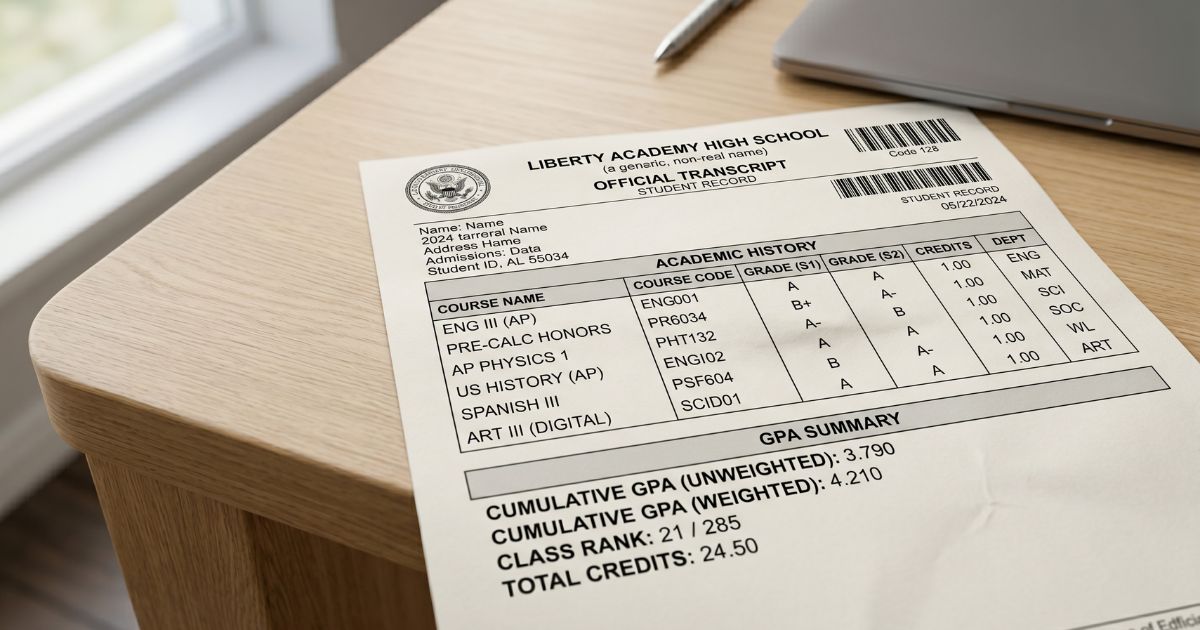
A high school transcript is one of the most important documents you'll carry out of school — and also one of the most misunderstood. If you've been asked for a transcript and aren't sure what it should contain, or you're simply curious what a real one looks like, this guide walks through every part of it.
What is a high school transcript?
A high school transcript is the official record of your academic work in grades 9 through 12. While a diploma confirms that you graduated, a transcript shows how you got there — every course you took, the grade you earned in each one, the credits attached, and your overall grade point average (GPA).
Colleges, employers, the military, and scholarship committees ask for transcripts because they tell a fuller story than a diploma alone. A diploma is a single line. A transcript is the whole record. For the bigger picture — college and university transcripts, official vs. unofficial copies, and how to request one — see what is a transcript.
What information is on a high school transcript?
Although layouts vary from school to school and state to state, nearly every high school transcript includes the same core sections:
- Student and school information. Your full name, date of birth, student ID, graduation date, and the school's name and address.
- Course list by year or term. Every class you took, usually grouped by grade level (freshman through senior year) or by semester.
- Grades. The letter or number grade earned in each course.
- Credits. The credit value of each course — most full-year courses are worth one credit.
- GPA. A cumulative grade point average, and often a GPA for each year.
- Class rank. Some schools include your rank relative to classmates; many no longer do.
- Standardized test scores. Occasionally SAT or ACT scores appear, though this is less common.
- A signature and seal. An official transcript carries the registrar's signature and the school seal.
What a high school transcript looks like
Most transcripts fit on one or two pages. The top holds the student and school details. The body is a grid: courses down the left, then columns for term, credits, and grade. The bottom summarizes total credits earned and cumulative GPA.
Here is a simplified example of how the course grid is typically laid out:
| Course | Year | Credits | Grade |
|---|---|---|---|
| English 9 | Freshman | 1.0 | A- |
| Algebra I | Freshman | 1.0 | B+ |
| Biology | Sophomore | 1.0 | A |
| U.S. History | Junior | 1.0 | B |
| English 12 | Senior | 1.0 | A |
| Below the grid, a summary line might read: Total Credits: 24.0 · Cumulative GPA: 3.6. | |||
| The visual feel matters too. A high school transcript is usually a clean, businesslike document — plain paper, a clear table, the school's name across the top, and a seal near the signature. It is not ornate the way a diploma is. If you want to estimate the GPA that would appear on yours, our free GPA calculator does the math from your course grades and credits. |
Official vs. unofficial transcripts
There are two versions of any transcript, and the difference matters:
- An official transcript is issued directly by the school, carries the registrar's signature and seal, and is usually sent sealed or transmitted electronically school-to-school. Colleges and employers that require verification want this version.
- An unofficial transcript has the same information but is printed by the student or downloaded from a school portal. It's useful for personal reference, applications in progress, or your own records.
If an institution needs to verify your record, only the official copy from your school's registrar will do. You can read more about how institutions check documents in our diploma verification guide.
Homeschool transcripts
Homeschooling families create their own transcripts, and they're perfectly legitimate for college applications when done carefully. The structure is the same — courses, grades, credits, GPA — but the parent or a homeschool program acts as the issuing party. Because this is a topic of its own, it's worth treating separately if you're homeschooling through high school.
What if you've lost your transcript?
Transcripts get misplaced just like diplomas. If you need your official record, the first stop is always your former school or district registrar — they keep transcripts on file for many years and can issue a fresh official copy.
If your school has closed, your state's department of education usually holds records for closed schools and can point you to the right archive.
For personal, display, or keepsake purposes — for example, framing your academic history alongside your diploma — DiplomaCraft creates replica transcripts on quality paper, recreated from the course and grade details you provide. These are novelty keepsakes, not official records, so for any application or verification you'll still want the official copy from your registrar. If you also need a matching diploma, our high school transcript product page shows the options. You can start from a transcript template and fill in your courses, grades, and GPA.
The short version
A high school transcript is your complete academic record: courses, grades, credits, and GPA, topped with your school's details and a seal. It comes in official and unofficial forms, and the official version — signed by the registrar — is the one institutions trust. Whether you're applying to college, starting a job, or simply organizing your records, knowing what a transcript should contain makes it far easier to spot when something is missing.
DiplomaCraft creates replica diplomas, transcripts, and certificates as novelty items for personal use, display, props, and replacement keepsakes. They are not official records and are not issued by any school.